"Laat stress in minuten verdwijnen, niet in uren."
Herstel snel van stressvolle momenten
De vergadering liep slecht. Je manager bekritiseerde je werk waar het hele team bij was. Je gezicht werd warm, je keel kneep samen, en nu, twee uur later, voelt je borst nog steeds beklemd. Je probeert verder te gaan, maar je lichaam heeft de boodschap nog niet begrepen. De stress zit vast in je zenuwstelsel, draait in een lus en houdt je geactiveerd, lang nadat de dreiging voorbij is.
Onverwerkte stress voelt niet alleen vervelend. Het stapelt zich op. Elk stressvol moment dat niet wordt losgelaten, tilt je basisspanning een beetje hoger. Aan het eind van de week functioneer je op 60% van je capaciteit, omdat je de fysiologische restanten van twintig onopgeloste stressreacties met je meedraagt. Je slaap lijdt eronder. Je geduld wordt dunner. Je besluitvorming verslechtert. Niet omdat je zwak bent, maar omdat je zenuwstelsel nooit het signaal kreeg dat het veilig is om te ontspannen.
De meeste mensen proberen zich uit stress te denken. Ze beredeneren waarom het hen niet zou moeten raken, waarom het zo erg niet was, waarom ze er gewoon overheen moeten stappen. Dat werkt niet, want stress is geen cognitief probleem. Het is een fysiologische toestand. Je lichaam wordt overspoeld met cortisol en adrenaline. Je hartslag is verhoogd. Je ademhaling is oppervlakkig. Geen enkele logische redenering raakt die biologie.
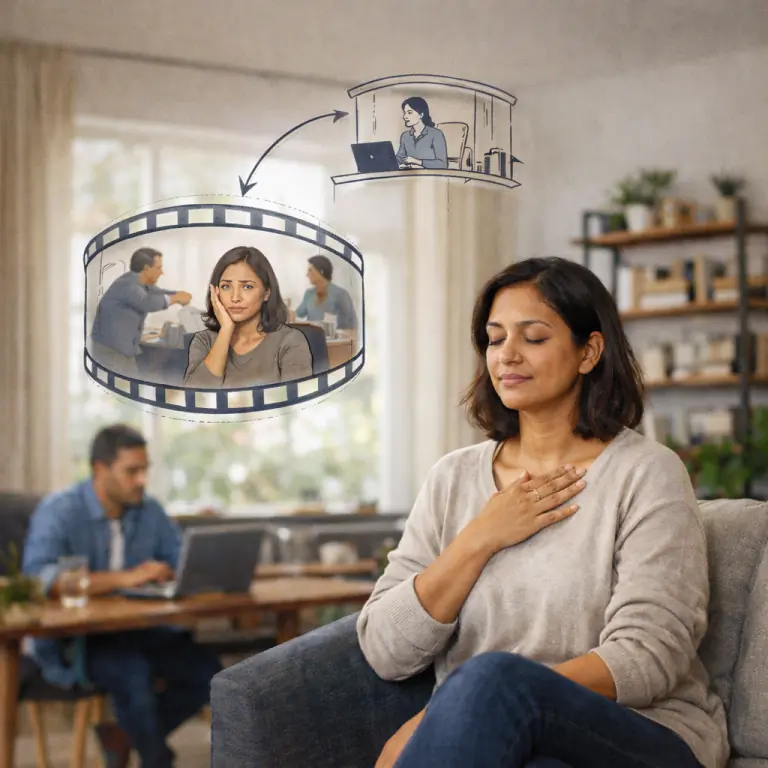
De Fast Phobia Cure-techniek, aangepast voor stress, werkt door afstand te creëren tussen jou en de ervaring. In plaats van midden in het stressvolle moment te zitten, bekijk je het van buitenaf. Deze dissociatie haalt de emotionele intensiteit eraf, zonder te onderdrukken of te ontkennen wat er gebeurd is.
Sluit je ogen. Stel je voor dat je in een bioscoop zit. Op het scherm voor je staat een stilstaand beeld van jou, vlak voordat het stressvolle moment begon. Jij zit in het publiek en kijkt naar jezelf op het scherm. Je ziet jezelf, maar je zit niet in die versie van jou. Je observeert van een afstand.
Zweef nu uit je stoel omhoog. Je bent nu in de projectiecabine en kijkt naar jezelf in het publiek, die naar jezelf op het scherm kijkt. Twee lagen afstand. Vanuit de projectiecabine ga je kijken hoe de jij in het publiek de film van de stressvolle gebeurtenis bekijkt. Druk op play.
Laat de film van begin tot eind lopen. Het stressvolle gesprek, het moeilijke moment, wat het ook was. Je kijkt naar jezelf terwijl je ernaar kijkt. Als de film het einde bereikt, zet je het beeld stil. Stap nu uit de projectiecabine terug naar je stoel in het publiek. Stap vanaf daar het einde van de film in, op het punt waarop de stress voorbij is. Je zit weer in jezelf, maar na afloop van de gebeurtenis.
Spoel nu de hele ervaring terug op drievoudige snelheid. Je zit er middenin en beweegt razendsnel achteruit door het stressvolle moment. De onuitgesproken woorden, de spanning die afneemt, alles beweegt in omgekeerde richting tot je terug bent vóór het begon. Open je ogen.
Herhaal deze reeks drie keer. Elke keer train je je zenuwstelsel om de gebeurtenis vanuit een afstandelijk perspectief te verwerken en haar vervolgens letterlijk om te keren. De emotionele lading neemt af. De herinnering wordt minder activerend. Je wist niet wat er gebeurd is. Je verandert hoe je lichaam het vasthoudt.
Een herstelanker geeft je een hulpmiddel voor directe stressverlichting, op elk moment dat je het nodig hebt. Denk terug aan een moment waarop je je volledig kalm en hersteld voelde. Niet verdoofd, maar echt op je gemak. Misschien na een goede training, een warme douche of terwijl je aan het water zat. Maak dat gevoel zo levendig en sterk als je kunt.
Maak op het hoogtepunt van die kalme toestand je fysieke anker. Raak met je duim je pink aan. Druk je handpalm tegen je borst. Knijp zacht in je oorlel. Kies wat natuurlijk en onopvallend voelt. Houd het anker tien seconden vast terwijl de kalmte op haar sterkst is. Laat los. Herhaal dit vijf keer met verschillende kalme herinneringen, en leg ze allemaal over dezelfde fysieke trigger heen.
Nu heb je een herstelanker. Als de stress toeslaat en je snel moet resetten, activeer je het anker en krijgt je zenuwstelsel toegang tot die kalme toestand. Het haalt de stressor niet weg, maar je hebt wel vaste grond onder je voeten in plaats van een vrije val.
Hier is je resetroutine van 60 seconden voor direct herstel na stress. De eerste 20 seconden: adem langer uit dan in. Vier tellen in, zes tellen uit. Dit activeert je parasympathische zenuwstelsel en geeft je lichaam het signaal dat het veilig is. De tweede 20 seconden: schud je armen en benen los. Echt schudden, alsof je water van je handen slingert. Zo ontlaad je de fysieke activatie. De laatste 20 seconden: activeer je herstelanker terwijl je je lichaam van top tot teen scant en bewust de spanning in elk gebied loslaat.
Doe deze routine op het toilet, in je auto of overal waar je een minuutje privacy hebt. Het doel is niet dat je je daarna perfect voelt. Het doel is te voorkomen dat de stress zich vastzet in je basistoestand. Je geeft je zenuwstelsel een afslag in plaats van het uren op hoge alert te laten stationair draaien.
Het meeste stressherstel gaat te langzaam, omdat mensen wachten tot de tijd het werk doet. Tijd helpt, maar actief verwerken gaat sneller. De dissociatietechniek verwerkt de gebeurtenis. Het herstelanker geeft je een resetknop. De routine van 60 seconden zorgt voor directe fysiologische regulatie. Samen brengen ze de hersteltijd terug van uren naar minuten.
Oefen de dissociatietechniek eerst op stressvolle gebeurtenissen uit het verleden. Pak iets van vorige week dat je nog dwarszit en doorloop de bioscoopreeks. Merk op hoe de lading afneemt. Installeer daarna je herstelanker met vijf kalme herinneringen. En de volgende keer dat de stress toeslaat, doe je meteen daarna de routine van 60 seconden en houd je bij hoeveel sneller je terugveert.
Stress is onvermijdelijk. Het urenlang met je meedragen niet. Laat het snel los en je capaciteit blijft hoog.
- Onderwerpen:
- #Emotieregulatie