Communicate Clearly Without Friction
You're not explaining poorly, you're translating into the wrong language for how they process information.
Read more…

Your coworker asks if you can cover their shift this weekend. You already have plans. You're exhausted. You need the time off. But they're looking at you with that expectant face and you hear yourself saying yes before your brain catches up. Now you're working Saturday and resenting them for asking, resenting yourself for agreeing, and wondering why you can't just say no like a normal person.
Boundaries aren't mean. They're not selfish. They're resource management. You have finite time, energy, and attention. Every yes to someone else is a no to something in your own life. When you say yes to the weekend shift, you're saying no to rest, to your plans, to your recovery time. The guilt you feel isn't proof that boundaries are wrong. It's proof that you've been trained to prioritize other people's comfort over your own sustainability.
Most people fail at boundaries because they frame them as rejection. You're saying no to the person, which feels like you're damaging the relationship. That's backwards. You're saying no to the request while maintaining the relationship. The request and the person aren't the same thing. You can decline what they're asking for without rejecting who they are.
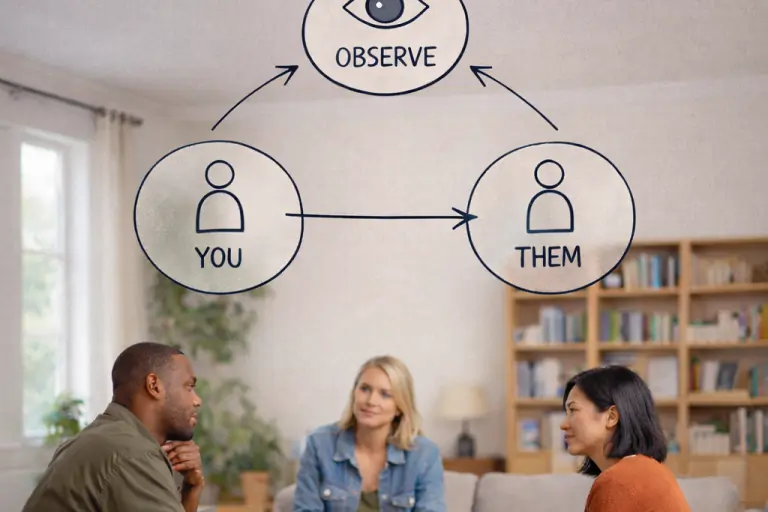
Apply the three perceptual positions to boundary decisions. First position is your perspective. What do you need? What are your constraints? What happens to you if you say yes when you mean no? Be honest here. Your needs aren't less important than theirs just because they asked first.
Second position is their perspective. What are they actually asking for? What need are they trying to meet? Sometimes the request is superficial and they'd be fine with an alternative. Sometimes it's genuine and important. You need to understand their position without automatically prioritizing it over yours.
Third position is the relationship view. What happens to the dynamic if you say yes when you don't want to? What happens if you say no? Most people assume saying no damages relationships. Usually it's the opposite. Resentful yeses create distance. Clean nos with good boundaries create respect.
Run through these three positions before you respond to boundary-testing requests. Don't answer immediately. Say "let me check my schedule" or "I need to think about that" and give yourself two minutes to assess all three angles. When you understand your needs, their needs, and the relationship impact, the right answer becomes clearer.
Clean language patterns let you say no without spiraling into justification. The more you explain, the more you're negotiating. Each reason you give becomes a problem they can solve or an objection they can overcome. Your reasons are for you, not for them.
Use this structure: acknowledgment plus boundary plus alternative if appropriate. "I understand you need Saturday covered. I'm not available this weekend. Have you checked with Sarah?" That's complete. You've heard them, stated your limit, and offered a potential solution that doesn't involve you.
Notice what's missing. No apology. No elaborate explanation. No "I'm so sorry but my aunt's friend's dog is sick and I really wish I could but..." The more you apologize, the more you signal that your boundary is negotiable. It's not negotiable, so don't frame it that way.
Three pre-scripted responses for common boundary situations. For time requests: "I don't have bandwidth for that right now." For favor requests: "That doesn't work for me, but I hope you find someone who can help." For obligation requests: "I'm not able to commit to that." All three are complete sentences. You can add warmth or context if the relationship warrants it, but the boundary stands either way.
Here's your boundary decision tree. When someone makes a request, ask: Do I want to do this? If yes, proceed. If no, ask: Is this a crisis where my help is truly needed and I'm uniquely positioned to provide it? If yes, consider it. If no, decline. If you're unsure, ask: Will saying yes create resentment? If yes, that's your answer. Resentful yeses poison relationships more than honest nos.
The guilt you feel when setting boundaries is old programming. Somewhere along the line, you learned that your needs are less important than other people's requests. That other people's disappointment is your responsibility. That saying no makes you a bad person. None of that is true, but the belief system runs automatically until you replace it.
Every time you set a boundary, the guilt will appear. That's normal. The guilt isn't evidence that you're doing something wrong. It's evidence that you're doing something different from your historical pattern. Do it anyway. Set the boundary, feel the guilt, notice that the relationship survives and often improves.
Practice on low stakes situations first. The person trying to sell you something at the mall. The charity cold caller. The email requesting a meeting you don't need to attend. Say no cleanly without justification and observe what happens. Usually nothing. They move on. You move on. The world continues.
Boundaries don't make you difficult. They make you sustainable. People who can't respect your no aren't upset about the boundary. They're upset about losing access to your resources without reciprocation. That's information about them, not about you.
You're not explaining poorly, you're translating into the wrong language for how they process information.

Match their intensity to show you're engaged, then pace them down to where the conversation can actually be productive.

You're not your thoughts, you're the awareness observing them, and that distinction changes everything.