
Set Boundaries Without Guilt
Agreeing when you don't want to damages relationships more than saying no.
Read more…
You explained your point three times. Each time, you used different words, clearer examples, slower pace. The other person is nodding, but their eyes tell you nothing landed. The conversation ends with both of you frustrated, both convinced the other one isn't listening. This isn't a communication problem. It's a translation problem.
Most communication fails because you're speaking from only one perceptual position while assuming the other person occupies the same space. They don't. They're looking at the situation from a completely different angle, with different priorities, different concerns, and different information. You're both describing the same reality, but from viewpoints so divergent that your words don't map onto their experience.
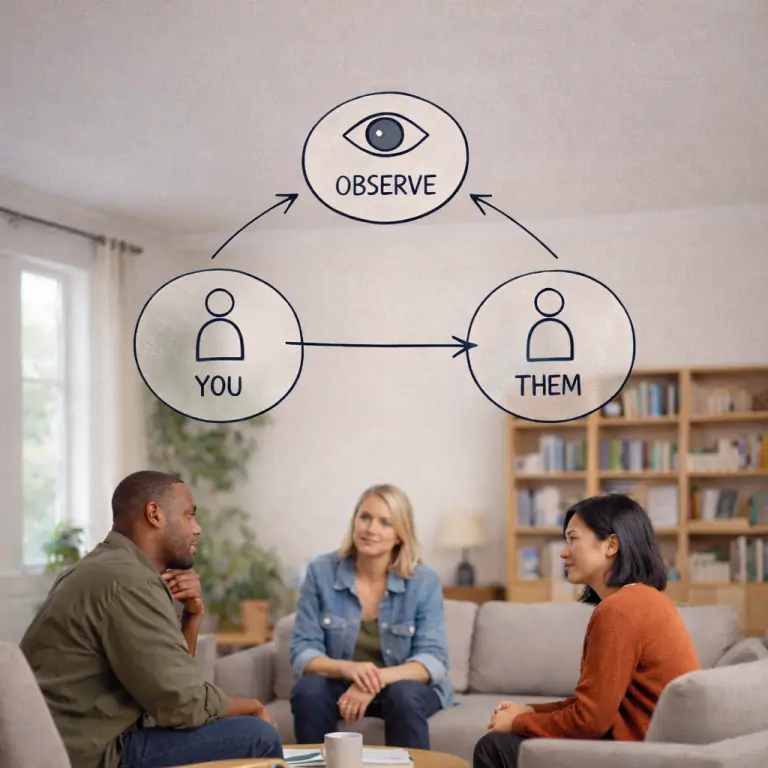
The three position technique fixes this. Position one is your perspective. What you see, what you want, what matters to you. This is where most people live during conversations, especially difficult ones. You're so focused on making your point that you never leave your own head.
Position two is their perspective. Not what you think they should see, but what they actually see from where they're standing. Their concerns, their priorities, their constraints. Most people skip this position entirely or fake it with a shallow guess. Real second position means temporarily setting aside your viewpoint and genuinely stepping into theirs.
Position three is observer perspective. You're watching the conversation from outside, like a camera in the corner of the room. From here, you can see patterns neither person notices while they're in it. You can spot where the communication is breaking down, where assumptions are misaligned, where both people are actually saying the same thing in different languages.
Before any important conversation, cycle through all three positions. Sit in your chair and think through your perspective. Then physically move to another chair and think through theirs. What do they need? What are they worried about? What would make this conversation successful from their angle? Then stand up, step back, and observe the interaction you're about to have. What does the outside view reveal that neither position sees alone?
This isn't empathy theater. It's reconnaissance. You're gathering intelligence about how to make your message land in their perceptual framework instead of just shouting louder in yours.
People process information through different representational systems. Some people think visually. Their language is full of seeing, looking, picturing, showing. Others are auditory. They talk about things sounding right, hearing you out, tuning in. Kinesthetic people use feeling language. Things click, resonate, or don't sit right with them.
When you match their system, communication becomes frictionless. If someone says "I don't see what you mean," responding with "let me paint you a picture" works better than "does that sound right?" You're speaking their native language instead of expecting them to translate.
Listen for their predicates in the first two minutes of conversation. Are they using visual words, auditory words, or kinesthetic words? Then match that system in your response. If they say "this looks problematic," you say "from this angle, here's what I'm seeing." If they say "something about this doesn't sound right," you say "let me tune this proposal so it resonates better."
Language patterns matter just as much as perceptual positions. Certain phrases create defensiveness automatically. "You need to understand" triggers resistance. "The problem with what you're saying" puts people in fight mode. "Actually" makes them dig in harder.
Replace "but" with "and." When you say "I hear you, but here's my concern," the but deletes everything before it. "I hear you, and here's my concern" lets both things be true simultaneously. Replace "you should" with "have you considered." One is a command, the other is an invitation. Replace "the right way to do this" with "one way that works is." You're reducing the stakes from right versus wrong to exploring options.
Ask more questions than you make statements. Not fake questions where you're just waiting to talk, real ones where you're curious about their map of reality. "What would need to be true for this to work from your side?" reveals constraints you didn't know existed. "What matters most to you about this situation?" shows you which variables they're optimizing for.
Here's your conversation prep template. Before any discussion that matters, write down the answers to these questions. Position one: What do I want from this conversation? What's my ideal outcome? Position two: What do they want? What are they protecting or pursuing? What would success look like from their chair? Position three: What's actually happening in this dynamic that neither of us can see while we're in it?
Then identify their likely representational system based on past conversations. Plan three key points you need to land, translated into their perceptual language. Visual people need the big picture first, then details. Auditory people need logical sequence and reasoning. Kinesthetic people need to understand the impact and feel the weight of it.
Run this template before your next three difficult conversations. The first one will feel mechanical. The second one will feel more natural. By the third, you'll notice people understanding you faster with less repetition and lower friction. That's not because you got better at explaining. It's because you got better at translating.
Clear communication isn't about perfect words. It's about building a bridge between your map and theirs. When you stop expecting them to cross over to your side and start meeting them in their territory, everything gets easier.
Agreeing when you don't want to damages relationships more than saying no.

Match their intensity to show you're engaged, then pace them down to where the conversation can actually be productive.

You're not your thoughts, you're the awareness observing them, and that distinction changes everything.